Critical
Rebuilt by modern scholars mainly from the earliest surviving manuscripts, several from the 4th century or before. It is the basis of most modern English translations.
Tyndale House Greek New Testament, Cambridge, 2017
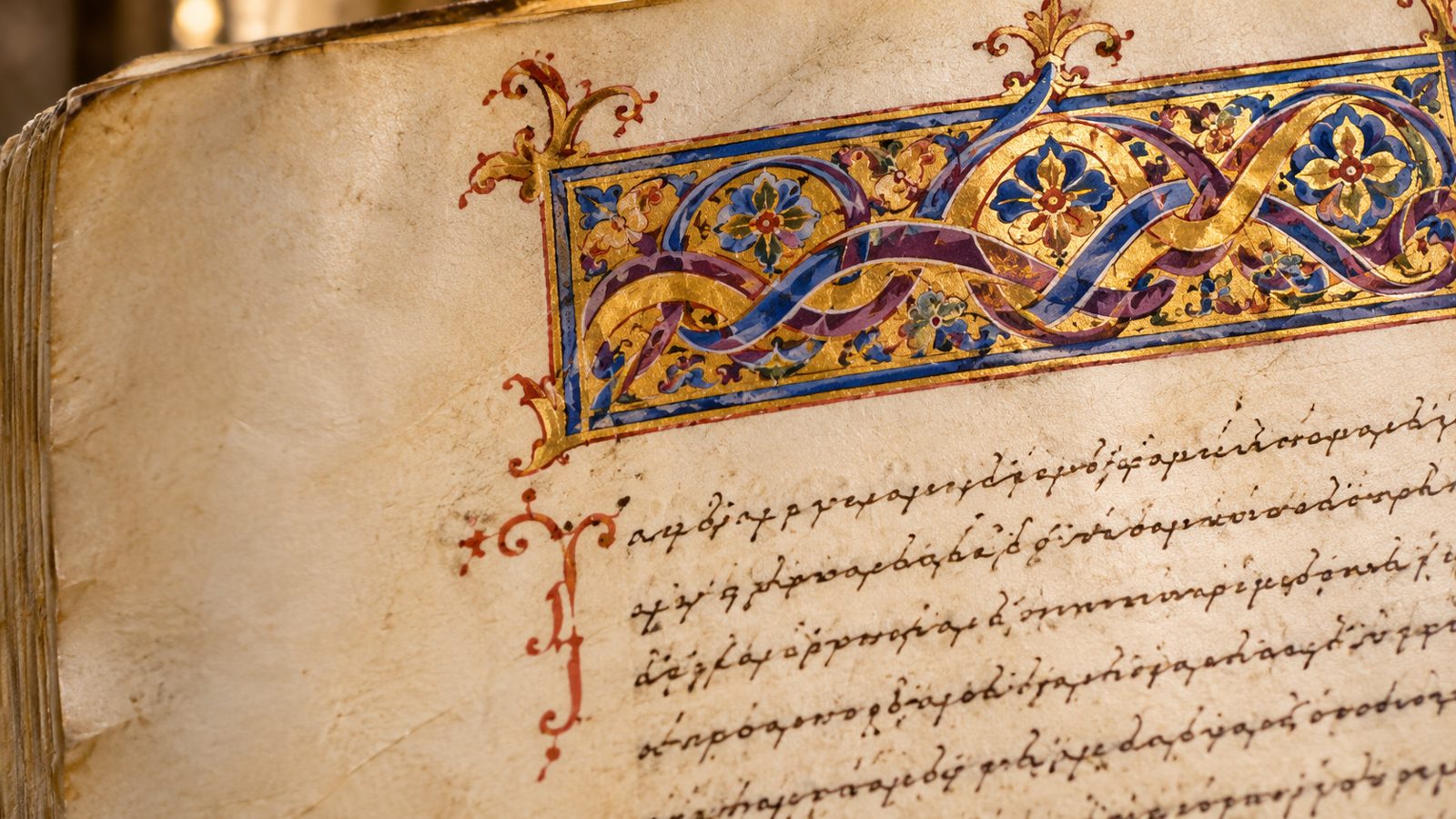
The Greek Scriptures in English and in Greek: a fresh paraphrase to read or listen to, the Greek word by word, and the story of how the text was copied and read in Byzantium.
No original manuscript of any book of the Greek Scriptures survives. What we have are thousands of handwritten copies made over fourteen centuries, which differ in small ways. Scholars have printed the text in different forms depending on which copies they trust. Switch between three of them at the top of the page.
Rebuilt by modern scholars mainly from the earliest surviving manuscripts, several from the 4th century or before. It is the basis of most modern English translations.
Tyndale House Greek New Testament, Cambridge, 2017
The form copied in the Greek-speaking churches of the Byzantine Empire. It is found in the great majority of surviving manuscripts, most of them written from the 9th century onwards.
Robinson–Pierpont, 2005
The printed Greek text that grew from Erasmus’s editions of 1516 onwards, based on a handful of late manuscripts. It is the Greek behind the King James Version of 1611.
Textus Receptus, as reconstructed by F. H. A. Scrivener, 1894
About 94% of the words are identical in all the main printed editions. The rest is where the history of the text becomes visible.
Greek words, glosses, grammar and edition data: Translators Amalgamated Greek New Testament (TAGNT), created by STEPBible.org based on work at Tyndale House, Cambridge. Licensed under CC BY 4.0 and available at github.com/STEPBible. For this reader the data has been reformatted, grammar codes written out in plain English, and editorial brackets and alternative verse numbers removed from the Greek.
Byzantine text: The New Testament in the Original Greek: Byzantine Textform, by Maurice A. Robinson and William G. Pierpont (2005). Public domain, from github.com/byztxt.
KJV Greek checked against Scrivener’s Textus Receptus (1894) in the public-domain transcription by Maurice A. Robinson, from github.com/byztxt.
English translation: Berean Standard Bible. Public domain. It follows the critical text, so where the Byzantine or KJV Greek has extra words, the reader shows a word-for-word rendering instead.
Gospel events and parallels: this reader’s own harmony, arranged in the order of the older harmonies and checked against Eusebius’s canon tables, as described in “The Gospels side by side”.
Other editions noted at each word: Nestle-Aland 27th and 28th editions, SBL Greek New Testament (2010), Westcott and Hort (1881) and Tregelles (1879).
The Paraphrase is Matthew’s, prepared with Claude from the critical Greek text: each passage is written in two passes, checked against the Greek, and footnoted where translations differ. The literal and plain English, and the verse study notes, are written by Claude Opus 5.5, an AI model made by Anthropic, and are not a published translation or commentary. The same model writes all of them, so their quality is consistent. Each is written once and kept as the reader’s central version. If you disagree with one, use its Report link.
Prepared by Matthew, an accountant with a long interest in Byzantine history (not the Gospel writer of the same name), working with Claude.
Version . .
Meanings are STEPBible’s brief glosses, not full dictionary entries. Counts are for the critical text’s main reading at each word. Tap a word to list every verse where it appears.
Tap a Greek word for its dictionary entry.
Paste or type a list of references to step through, e.g. Heb 5:1; Rom 8:26; Rev 2:10. It stays on this device.
A copy to keep or send to someone.
 Illustration made for the project
 Illustration made for the project
▶ Watch the daily readings as short videos on YouTube: KOINE, a daily reading
Gospel readings, and the red openings marked as checked, from the lectionary in Codex Zacynthius (Gregory–Aland L299), transcribed by the University of Birmingham’s Codex Zacynthius Project (CC BY 4.0). Epistles from Scrivener’s 1894 table and Gregory’s 1900 tables of Byzantine readings, and today’s Orthodox list. Greek: Robinson–Pierpont Byzantine text (2005). English: Matthew with Claude; readings not yet accepted in the Berean Standard Bible. Greek voice: Joy, by Chara Kaltsou (CC BY-NC 4.0). English voice: George (Kokoro).